some bullshit: citation, “special issue of Journal of Radical Librarianship,” Vol. 12, 2026.
12
I come to this special issue on citation as a pedestrian with perhaps a pedestrian take on the subject. I am not an academic or a librarian. I am, though, a library worker. I felt compelled to submit to this issue because for a recent project I neglected to center citation as a way to show my thought work. In 2023, I completed recortes which is a 16mm experimental animation and artist book. In that project I was interested in the generational loss of campesino knowledge systems in my family, now receding due to migration. The project was in conversation with scientific field notes that help structure a very specific way of engaging in the act of observation; one of categories and compartmentalization that subsequently places pressure on the nature of belonging. I was interested in field notes as documentation for observations that support narratives of objectivity that aren’t just confined to the sciences but spill into the everyday and shape our relationship with the natural world.
The artist book includes a series of images from herbaria in the US and Colombia juxtaposed with photographs, family WhatsApp messages and drawings. It is dedicated to the Cerulean warbler whose numbers have been declining due to habitat loss from pressures to shift from shade coffee to sun coffee in hopes for increased productivity. My family grew up on a coffee farm in Colombia and I was interested in contrasting deep, lived relationship with various plants from the farm, the co-constructed remembering of a place, my relationship with these plants as exported, mass produced products (e.g. guava paste or coffee candies), and its pressing in an archive–a plant flattened, labeled and set on a white sheet of paper next to a color chart to allow for accurate color representation once photographed.
To publish the images from the herbaria, the website noted I needed to include citations. I reached out to the contacts listed on the digital collection’s website to double check copyright and citations. Interestingly, one of the places I needed approval from to publish shared that my usage was stretching the definition of their intended purpose for the digital photographs. Their usage scenario lists scientific, conservation or education as valid uses of the images. I hadn’t anticipated the various hurdles I needed to clear (over 15 emails for one image) to use a photograph of a pressed plant. If I’m honest, I’m still not sure I understand how there is copyright over a plant that someone yanked from the ground, pressed, and then took a picture of.
Just after I finished printing the book, I was presenting the film component at a symposium. After having screened the film numerous times around the globe, I realized– during this event–that I hadn’t included citations for an archival text, as well as databases, books and documentaries I used or referenced in the film. The other films screening were attentive to citations, and I watched as they scrolled in the credits feeling as if I had committed a major faux pas. Upon noticing the omission, I tried to cite the various sources I omitted in a notebook, but I lost the shape the citational format is supposed to help contain.
The images from the herbaria were easy to cite, but what about memories that surfaced from conversation amongst my family that pieced together a different type of story from these same plants? In the book I asked my family to share their memories of plants they grew up connected to on the farm. My Tio Jairo shared that growing up his father would make him greet a tree, a chiraco, also known as Toxicodendron striatum, every time he passed it. A tree with similar effects as poison ivy required respect, just as any person visiting the farm. “Buenos días compadre chiraco. Hasta luego compadre chiraco.” Or planta de escobilla, Sida Rhombifolia, remembered by my Tia as a hair conditioner that helped gently detangle her knots and by my mother as a plant used to sweep the floor. With this project I wanted to share something with others about what I saw as a shifting and multivocal nature of observational experience and I partially explored this with my family via memory and conversation. But with the film, I also wanted to create a sequence of observations that didn’t just focus on my family, but the influences that have shaped my own sense making; an observational experience that recognizes noticing as something framed by various perceptual regimes across time and place.
Photosensitivity warning. Fast flickering and flashing images.
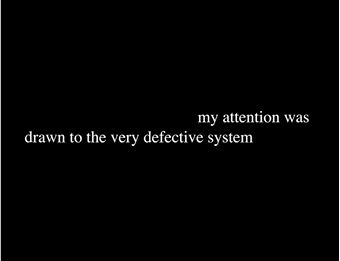
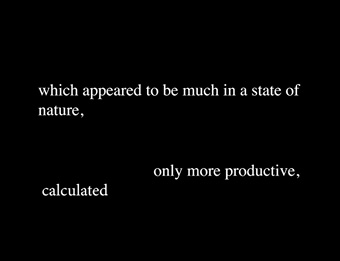
Excerpt from recortes.
In the film, one archival text I failed to cite was a journal written in 1824 by Charles Stuart Cochrane, a Scottish navy officer in the Royal Navy, who documented his journey across Colombia as he searched for ways to exploit the natural abundance of the region. His journal is filled with observations for opportunities to incorporate “the most improved European methods” and possibilities for an “agricultural capitalist” to introduce more efficient technologies, such as seed sowing machines and ploughs, despite his own admission that “the corn-land had only had the surface turned up with a hoe, but nevertheless produced abundantly.” But what struck me in his text, besides the persistence and longevity of this outlook, was his recounting of the search for gold in la Laguna de Guatavita, a lake just outside Bogota, Colombia.
When I was 10, I visited la Laguna de Guatavita for the first time. While walking a trail that overlooks the lake, I stared into a depth that seemed both flat and deep; a mirror reflecting the vastness of the sky above and the surrounding trees and also a body of water with depths that penetrate both earth and time. It almost looked like it was doubling the environment that embraced it, making the division between land and its reflection difficult to distinguish. I soon learned that this was a sacred place where native Muisca ceremonies were conducted prior to the Spanish invasion. Gold was an important element during these rituals, a fact that once discovered by the Spanish in the 1500’s began a series of attempts (until 1965!) to drain the lake in search of these gold objects. →, →, →, →, →, → I know this story from the guide who led us through the trails, plaques on excavated gold objects at the Museo de Oro in Bogota, from films, from my family, from the land that shows the scars - the evidence of these attempts is etched into the mountains themselves through crevices and past water level marks.
While Cochrane’s main objective wasn’t to drain the lake, he stopped briefly in the area to demonstrate syphoning as a method that could be used by his close friend, Señor Jose Ignacio 'Pépe' Paris, who had been trying but was unsuccessful in emptying the lake. After Cochrane arrived, Pépe took Cochrane onto the water in a canoe. Pépe recounted his version of the story that gave plausibility and motivation to his project. He explained how the cacique, the chief of the Musica people, would cover himself in gold and then submerge into la laguna. Those in attendance would make gold offerings, burying them near or tossing them directly into the water. This ritual is part of the storytelling that shaped the famed search for El Dorado, tales of a city constructed out of gold that sent many wandering across the Americas.
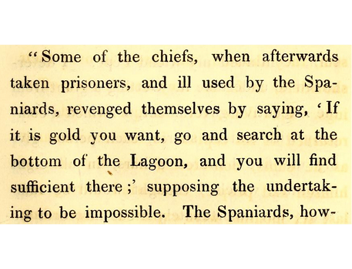
Cochrane’s recounting of Señor Pépe Paris’s version of this story includes the supposed response of the Musica people to the Spanish demand for gold:
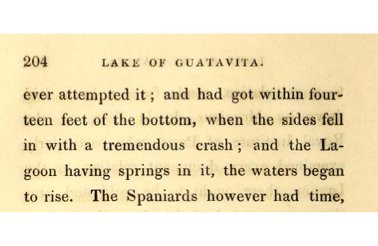
Excerpts from Journal of a Residence and Travels in Colombia by Charles Stuart Cochrane.
Like any story passed from person to person, residue of Pépe and Cochrane’s worldview are held in the retelling. Pépe Paris is the person Cochrane quotes and whose version of the story elaborates on the cacique’s response by adding, “supposing the undertaking to be impossible”. Pépe Paris recounts the failures of the Spanish, although he has similarly “attempted it”. During these attempts, the Spanish forced Indigenous workers to empty the lake by scooping water and passing it down in clay pots. Their second attempt had roughly 8,000 workers cut a notch in the side of the mountain that eventually caved in killing most of the workers →, →. Pépe Paris had laborers dig a trench. What strikes me every time I re-read Cochrane’s passage is the profound absurdity to go and search the lake for gold by attempting to drain it. Absurdity is relative I suppose. The Spanish saw the suggestion not as a ridiculous endeavor, nor did Cochrane, Pépe Paris or the many others after them, but a “problem” that labor and technology could solve.
As distant as Cochrane’s journal may be from me temporally, his capitalist outlook on efficiency and commodification thrives. Surely, I can’t trace dried guascas in a bag sold at my local international grocery to Cochrane, but I think it doesn’t take much to pull at the underlying logic as entangled; land as commodity, culture as economy. While recortes may not formally cite where I’ve sourced material, it does engage with genealogies of thought via image, sound and time. The film surfaces these lineages through emergent relationships during the act of observing, e.g. moving from the sound of field recordings of bird songs collected in databases to Cochrane’s journal in a digital collection to geospatial data via Google maps to color chip carts from Lowe’s. These disparate elements have tangled roots that fixate on standards as a route to objectivity. Finding a way to narrow these dispersed influences felt difficult to synthesize down to fit into a single, pointed citation. Like observation distilled into field notes, citations seemed another mechanism to separate a complex world of relationships and I wondered about the impetus to standardize how knowing is traced.
This call for submissions allowed me the opportunity to explore citation as a formal strategy meant to facilitate discovery. Its form speaks to an underlying method of segmentation and extraction of information meant to connect the ever-increasing flow of information. Last Name, First Name. Title of Book. Publisher, Year of Publication. It was the form that drew me in. It felt so familiar, boasting an air of control and objectivity as most standards do. This was evidenced in the numerous articles and educational films I read and watched to learn about the development of the standard that were peppered with language about control, discipline and making the information landscape more “habitable”→,→.
Knowing little about the subject of bibliography, I started reading about what problem the standard was trying to solve for and where investment in its adoption emerged. I soon learned its development was in part to due to US investment in research after World War II, with colleges and universities as primary research partners. This created a rise in the production of journals and publications and required complex solutions to manage. While forms of citations and indexes had existed, the overwhelming amount of information and the growing professionalization of various fields required more detailed standardization.
The more I read, the more the tangle between computer science and information science blurred. As computing technology advanced, information retrieval became a vested interest for both parties. With the advent and subsequent proliferation of computers, citational indexes and bibliometrics were able to build on citation standards to expand and automate this network of connection. But citation standards were just one way of attempting to control information. In the 1960’s the Library of Congress had recommended investing in automation to help make cataloging and information retrieval more efficient and hired Henriette Avram to lead the project. She had experience working with the NSA, the National Security Agency, and worked to develop the MARC format for bibliographic data. This period also saw the formalizing of the MLA and APA style sheets, along with internet protocols developed by DARPA, the Department of Advanced Research Projects Agency. Digital library infrastructure was another strategy for connecting newly published research via DARPA funded projects like the CT-RS project in the 90’s which aimed to “create network access to archives of technical information in the domain of computer science”→. These new infrastructures established protocols and architecture to govern how data would be exchanged, segmenting information in order to filter and package it, while ideally allowing for interoperability between various applications.
José, the reviewer for this issue, shared various readings he thought I would find interesting given what I had written thus far. One of the materials he shared was meeting notes from the Association of Research Libraries. In 1970, Allen Veaner, Assistant Director for Bibliographic Operations at Stanford University Libraries, presented a paper titled “Major Decision Points in Library Automation”. In a section on National Goals and Priorities he advocates for standardization as a pathway to building more efficient information systems. He writes:
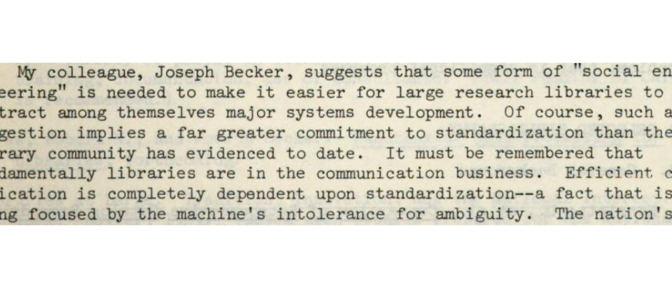
Screenshot from the 1970 Minutes of the Meeting, Volumes 75-78 by Association of Research Libraries
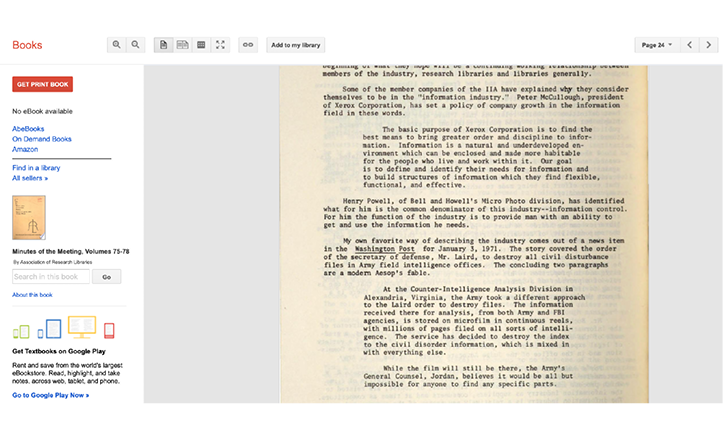
Veaner goes on to inquire about the concessions libraries can make regarding “local autonomy in technical processing to benefit from the economies of standardization”. Later in the meeting, Paul Zurkowski, Executive Director at the Information Industry Association, presented in the hopes of encouraging alignment between “industry, research libraries and libraries generally”. Veaner and Zurkowski, though brought in at different points of the meeting for different topics, stress the need for adoption of standards in connection with emerging information industries to keep libraries relevant and operating efficiently. This alignment today can be easily cited with a simple screenshot that captures the fuller environment where I pulled this quote:
Screenshot of Google Books interface with page from the 1970 Minutes of the Meeting, Volumes 75-78 by Association of Research Libraries
A text digitized through the Google Books project that offloads the “technical processing” to Google who, along with others, have used this corpus to train LLM’s for AI technology that promises even more information access efficiencies. These efficiencies don’t just support lauded claims of democratizing information. In just one recent example from April 2025, the Intercept reported on Google systems being used at the US and Mexico border to create a virtual wall; “CPB is purchasing computer vision powers from two vendors, IBM and Equitus. Google, the documents show, will play a critical role stitching those services together by operating a central repository for video surveillance data”. Google’s building blocks were developed out of the Stanford Digital Library project (also funded by DARPA, the NSF, and various other government agencies and academic institutions) and stem from aims to sort and rank “vast collections of uncontrolled heterogeneous documents” through their PageRank algorithm; “bringing order to the web”. This algorithm takes “an objective measure” of a webpage’s importance by connecting number or frequency of citations (or links) to credibility. Similar to Eugene Garfield’s citation index, control and credibility of information is enabled via citation frequency. Patterns are measured, calculated and ranked. But what lineages of thought and methods of observation are filtered out? How do citations contribute to perceptual regimes that shape who is credible enough to make connections →, →?
The more I read about the intersection of government, industry and academic libraries converging under promises of information control and efficiency, piggybacking on lauded library values of access and democratizing information, the more citation fluctuated as both a tool to connect knowledge and a tool of western epistemology that facilitates control. At what point does even the diluted Musica response to “go and search” generate reflection that academic libraries and higher education have also continued in the legacy of Pépe Paris?
Algorithms and machine learning lay claim to new efficiencies in connecting us to information. New AI information systems are able to search and sort digital image collections by color, feature type or category. But does a system whose methods prop-up government surveillance while using up excessive amounts of natural resources parallel an absurdity as remarkable as draining a lake for gold? I can know the Cerulean warbler’s population decline is due to changes in agricultural practices from reading research papers. I can read that these changes were driven by goals for efficiency and output that have depleted the soil. These connections are facilitated by citation standards within the larger infrastructure of higher education that frames research and credibility in very particular ways just to connect people back to something Indigenous peoples and those who work the land have known for centuries. Do we need to know in this way to value the life around us enough to greet it as a friend? I realize benefits have come from these infrastructures and standards and yet I wonder, as what counts as information continues to expand, growing along lines of both what can be commodified and used for surveillance, can technologies built on separating our world be tasked with bridging it back together?
While writing this text I made a series of creative outputs trying to shift through my thoughts. The visual reflections below linger on Cochrane’s observations juxtaposed with undulating images from digital collections interfaces, drawings, and archival images I encountered while making recortes and writing this piece. Visual segmentation as an aesthetic nod towards objectivity is found not just in field notes or the botanical specimens I encountered in the herbaria but in discovery layers for digital collections and digitization standards as well. The hope is for this text and these images to prompt reflection on the way visual aesthetics also speak to perceptual regimes; ideologies suspended in the background.

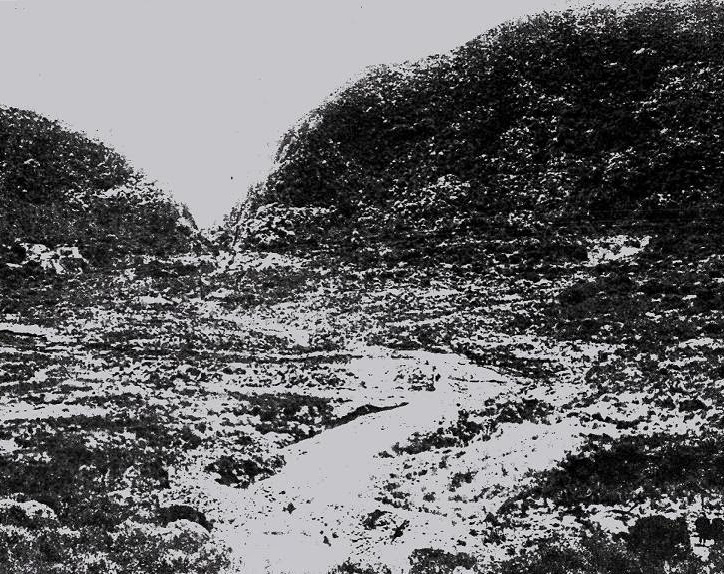
The drained lagoon of Guatavitá by von Konrad Beisswanger, 1911. Public domain.